If you work in mineral processing, you’re dealing with "concentrate grade" every single day. It’s plastered all over production reports, and you can’t negotiate a price with a smelter without it.
But what exactly is concentrate grade? How do you calculate it? And why the hell does it bounce around so much?
Let’s cut through the jargon. Below is a no-nonsense, plain-English breakdown of concentrate grade. Whether you’re a rookie or a seasoned vet, this is what you need to know to get the job done right.
Simply put, concentrate grade is the percentage of valuable mineral in your final, purified product by weight.
Raw ore straight out of the ground is a messy cocktail of useful metals, useless gangue, and random impurities. You can’t feed that straight into a smelter. After you run it through crushing, grinding, flotation, gravity separation, or magnetic separation, you strip away the junk. What’s left—the enriched, valuable stuff—is your concentrate.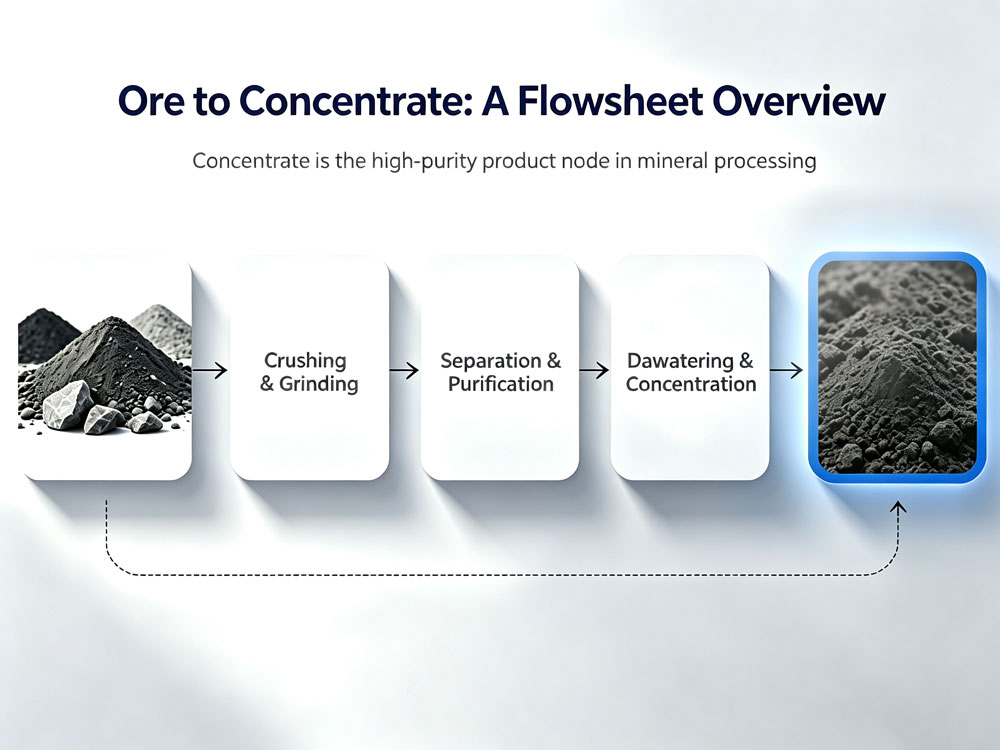
The higher the grade, the purer your product. It’s the ultimate scorecard for how well your plant is performing.
Here’s the easiest way to picture it:
Say your copper concentrate grade is 20%. That means out of every 100 tons of dry concentrate, 20 tons are pure copper. The other 80 tons is just gangue and impurities.
💡 Crucial Note: Always calculate concentrate grade on a dry weight basis. If you factor in moisture, your numbers are useless for comparison.
Not all grades are created equal.
Don’t try to apply one benchmark across the board. Magnetite needs a high grade to be viable, copper usually sits in the 20–30% range, and a gold concentrate can be incredibly profitable even at just a few grams per ton.
The math is straightforward:
Concentrate Grade (β) = (Weight of Valuable Mineral / Total Dry Weight of Concentrate) × 100%
In the real world, plants don’t weigh the valuable mineral directly. They run chemical assays to find the mineral content and multiply it by the total dry weight.
If you have concentrates from three different shifts, do not just add the grades and divide by three. You need a weighted average.
Weighted Average Grade = (Q₁×β₁ + Q₂×β₂ + Q₃×β₃) ÷ (Q₁ + Q₂ + Q₃)
The shift that produced the most tonnage gets the most weight. That’s how you get a number that actually means something.
Every operator has asked this: “Everything is running exactly the same, so why is the grade jumping around?” It comes down to two things: the ore you’re fed, and how you’re running the plant.
The Ore Dictates the Baseline: If your valuable minerals are coarse and cleanly separated from the gangue, grinding easily liberates them. Separation is a breeze, and high grades are easy to hit. But if the minerals are finely disseminated and locked tight with the gangue, you’re fighting an uphill battle. Even fine grinding might not liberate them. Those locked particles end up in your concentrate and drag your grade straight into the dirt. Some ores are just naturally stubborn.
Process Parameters Are Your Steering Wheel: Once the ore is locked in, your process parameters make or break you. Key variables include grind size, reagent dosages, flotation time, pulp density, equipment RPM, magnetic field strength, and feed rate.
Concentrate grade doesn’t exist in a vacuum. It’s tied directly to recovery rate, head grade, and yield.
The most critical relationship is the grade-recovery trade-off. Push the grade too high, and you’ll throw valuable minerals into the tailings, causing your recovery rate to plummet. Chase recovery too hard, and you’ll pull in a ton of impurities, causing your grade to suffer. It’s a classic seesaw. Your job as an operator isn’t to max out one metric; it’s to find the sweet spot that maximizes overall profitability.
Plants assay head, concentrate, and tailings every shift. These numbers tell you if your circuit is healthy. If your actual recovery is way off from your theoretical recovery, you’ve got a problem. Start hunting for bad sampling, leaks in the equipment, parameter drift, metal losses, or lab errors.
Grade dictates your revenue. Smelters buy on grade. A fraction of a percent can mean thousands of dollars. Exceed impurity limits, and they’ll hit you with penalties. Grade isn’t just a technical metric; it’s a financial one.
Often, the ceiling on your grade was set before the ore ever hit the plant.
On the floor, the usual suspects are:
Grade drops are rarely a single point of failure. They’re usually a perfect storm of ore, reagents, equipment, and human error.
5.1. Test First, Tweak Later: Don’t just guess and check on the plant floor. Run metallurgical tests to find your baseline: optimal grind size, reagent suite and dosages, flotation time, and whether you need regrinding, extra cleaning stages, or a hybrid flowsheet.
5.2. Nail the Grind Size: The golden rule is to liberate, don’t overgrind. Coarse leaves minerals locked; fine generates slime. Both kill your grade.
5.3. Lock Down Your Reagent Regime: Consistency is king. Collectors, frothers, depressants, modifiers—keep your dosages rock-solid. Expired or badly mixed reagents will sabotage your circuit. For complex ores, stage your reagent additions to boost selectivity.
5.4. Add Cleaning or Regrinding: If your rougher concentrate is dirty, step it up. Add more cleaning stages, regrind the rougher concentrate, run a gravity-flotation hybrid circuit, or pre-concentrate and reject tailings early. Let the test work dictate the flowsheet.
5.5. Blend Your Feed: If your head grade is all over the place, your concentrate grade will be too. Blend your ore stockpiles to feed a consistent, predictable head grade to the plant. Stop letting high-grade and low-grade ore alternate randomly.
5.6. Get Real-Time Data: If you can afford it, install online grade analyzers. Watching head, concentrate, and tailings grades in real-time lets you tweak the circuit before the lab results come back hours late.
5.7. Maintain Your Gear: Bad equipment ruins good chemistry. Check for demagnetized magnetic separators, flotation cells with poor aeration, worn-out impellers, clogged pulp lines, and unstable sampling systems. Fix the hardware before you blame the process.
5.8. Train Your Operators: A lot of grade swings come down to sloppy operation. Operators need to know exactly what to watch, what to adjust, when to add reagents, when to drop the froth level, and when to call the lab. Standardize your procedures to cut out unnecessary variance.
Concentrate grade is the heartbeat of a mineral processing plant. It dictates product quality, recovery trade-offs, operating costs, and your bottom line.
Don’t get tunnel vision on grade alone. Keep your eyes on the whole dashboard: head grade, concentrate grade, tailings grade, recovery, yield, and impurities.
To stabilize your grade, focus on three things:
Nail those three, and your plant will run smooth, efficient, and profitable.
Q1: Is higher concentrate grade always better?
A: Nope. Pushing grade too high means you’re throwing valuable metal into the tailings. Your recovery tanks, and you lose money. The right grade balances smelter specs, metal prices, processing costs, and recovery.
Q2: If my head grade is low, is it impossible to produce high-grade concentrate?
A: Not necessarily. Low head grade doesn’t mean your concentrate grade has to be low. As long as the valuable minerals can be fully liberated and there’s enough separation difference from the impurities, you can still hit your targets. Just expect higher costs and a more complex process.
Q3: What’s the relationship between concentrate grade and tailings grade?
A: They’re linked. If your process is stable but you push the concentrate grade higher, your tailings grade will likely rise too (meaning you’re losing metal). But if you optimize the process properly, you can actually raise your concentrate grade while lowering your tailings grade. That’s the holy grail.
Q4: How do I know if a low grade is an ore problem or a process problem?
A: Run an amenability test. If you can hit your target grade in the lab, your on-site process or operators are the problem. If you can’t hit it in the lab, the ore is fighting you. You’ll need to rethink your flowsheet (e.g., adding regrinding or a combined process).
