
Circular Vibrating Screen: Engineering Design, Capacity Control & Heavy-Duty Screening Applications
Circular Vibrating Screen: Engineering Design, Capacity Control & Heavy-Duty Screening Applications
In large-scale mining and aggregate crushing plants, the circular vibrating screen remains the most widely adopted screening equipment for coarse, medium, and high-capacity material separation.
Unlike linear vibrating screens that emphasize accuracy and fine separation, circular vibrating screens are engineered for high throughput, strong stratification, and heavy-duty operating conditions. They are typically installed in primary, secondary, and tertiary crushing stages, where stable capacity and mechanical reliability are critical to overall plant performance.
This article provides an engineering-grade analysis of circular vibrating screens, covering structural design, motion mechanics, capacity control, selection methodology, and system-level integration with crushers and screening circuits.
Table of Contents
- 1. Working Principle of Circular Vibrating Screen
- 2. Structural Design and Mechanical Configuration
- 3. Heavy-Duty Applications in Mining & Aggregates
- 4. Screening Capacity and Stratification Mechanism
- 5. Engineering Selection Criteria
- 6. Integration with Crusher & Screening Systems
- 7. Reliability, Wear Control, and Maintenance Strategy
- 8. Circular vs Linear Vibrating Screen: Engineering Comparison
- 9. Conclusion
1. Working Principle of Circular Vibrating Screen
A circular vibrating screen operates by generating a circular motion of the screen deck through a single-shaft exciter or eccentric block mechanism. The exciter is driven by an electric motor via a flexible coupling, producing centrifugal force that causes the screen body to vibrate in a circular trajectory.
This circular motion enables material on the screen surface to:
- Stratify efficiently by particle size
- Move forward in a spiral-like path
- Maintain continuous contact with the screen media
The result is a robust screening process suitable for high feed rates, large particle sizes, and abrasive materials commonly found in mining and quarry operations.
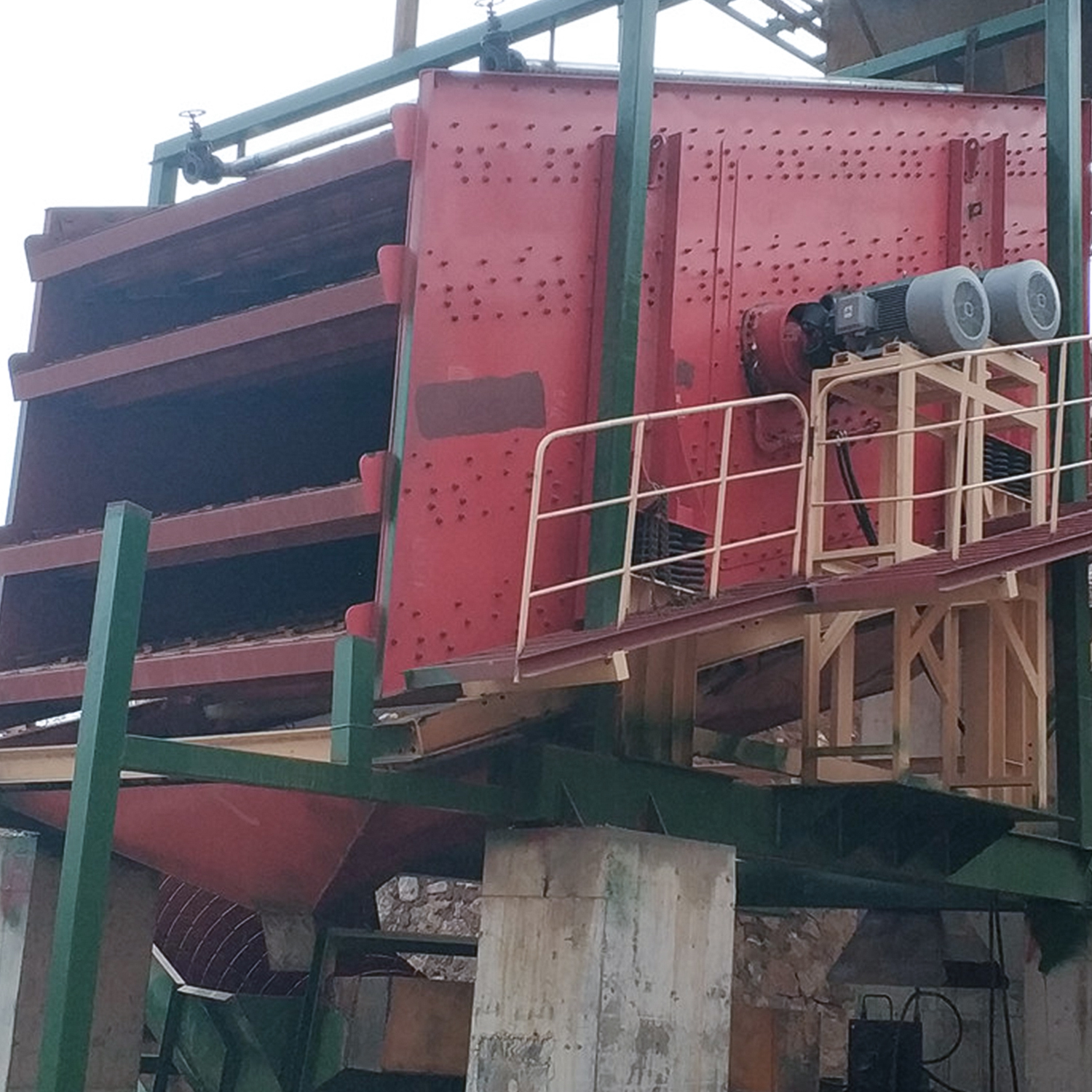
2. Structural Design and Mechanical Configuration
From an engineering perspective, the circular vibrating screen is designed to withstand continuous dynamic loads and harsh operating environments. Its mechanical structure prioritizes strength, fatigue resistance, and ease of maintenance.
2.1 Screen Box and Side Plates
The screen box is typically fabricated from high-strength steel plates, with side plates reinforced by transverse stiffeners. This design minimizes deformation under vibration and ensures long-term structural stability.
2.2 Eccentric Shaft / Exciter Assembly
The exciter is the core component of a circular vibrating screen. Key design considerations include:
- Eccentric mass configuration
- Bearing selection and lubrication system
- Sealing performance against dust and moisture
Proper exciter design directly affects vibration intensity, screening efficiency, and service life of the equipment.
2.3 Screen Deck and Screen Media
Circular vibrating screens commonly use multi-deck configurations to achieve different product size fractions. Screen media options include:
- High-tensile steel wire mesh
- Rubber screen panels
- Polyurethane modular panels
The choice of screen media balances open area, wear resistance, and maintenance cost.
3. Heavy-Duty Applications in Mining & Aggregates
3.1 Primary and Secondary Crushing Circuits
In crusher and screening systems, circular vibrating screens are typically installed after jaw crushers or cone crushers to classify material and control crusher feed size.
Their high capacity ensures that upstream crushers operate under stable load conditions, preventing choke feeding or idle operation.
3.2 Aggregate Production Plants
For aggregate plants producing construction materials, circular vibrating screens handle large volumes of stone with varying gradation. They are well-suited for producing coarse and medium aggregates used in concrete, asphalt, and road base applications.
3.3 Mining Ore Screening
In mining operations, circular vibrating screens are used to screen:
- Run-of-mine (ROM) ore
- Crushed ore before grinding
- Final products before stockpiling
Their rugged design makes them ideal for abrasive ores and high-impact loading conditions.
4. Screening Capacity and Stratification Mechanism
The high capacity of circular vibrating screens is primarily attributed to their effective stratification mechanism. As material moves on the screen surface, vibration causes larger particles to rise while finer particles migrate downward toward the screen apertures.
4.1 Key Factors Affecting Capacity
- Screen area and deck configuration
- Vibration amplitude and frequency
- Screen inclination angle
- Feed size distribution
Proper adjustment of these parameters allows engineers to optimize throughput without sacrificing screening efficiency.
4.2 Inclination Angle Optimization
Circular vibrating screens typically operate at an inclination angle between 15° and 25°. A higher inclination increases material flow speed, while a lower angle improves separation accuracy.
5. Engineering Selection Criteria
Selecting a circular vibrating screen for a mining project requires a comprehensive evaluation of process requirements and operating conditions.
5.1 Material Characteristics
- Maximum feed size
- Bulk density
- Abrasiveness
- Moisture content
5.2 Capacity Requirement
The required screening capacity must match the throughput of upstream crushers. Oversized screens increase capital cost, while undersized screens create bottlenecks.
5.3 Integration with Downstream Equipment
Screen discharge characteristics must align with conveyor systems, stockpiles, or further processing equipment.
6. Integration with Crusher & Screening Systems
Circular vibrating screens are a central component of complete crushing plants. They are commonly integrated with:
- Primary jaw crushers
- Secondary and tertiary cone crushers
- Impact crushers (for shaping)
In well-designed plants, screens not only classify material but also protect crushers by removing fines or oversize material at appropriate stages.
7. Reliability, Wear Control, and Maintenance Strategy
Due to continuous high-load operation, circular vibrating screens require a disciplined maintenance strategy.
7.1 Bearing and Lubrication Management
Bearings operate under alternating loads and must be properly lubricated to prevent overheating and premature failure.
7.2 Wear Protection
Wear liners, rubber coatings, and reinforced screen decks are commonly used to extend service life in abrasive applications.
7.3 Preventive Maintenance
- Routine inspection of bolts and fasteners
- Monitoring vibration amplitude
- Timely replacement of worn screen media
8. Circular vs Linear Vibrating Screen: Engineering Comparison
| Aspect | Circular Vibrating Screen | Linear Vibrating Screen |
|---|---|---|
| Motion Type | Circular | Linear |
| Capacity | High | Moderate |
| Screening Accuracy | Medium | High |
| Typical Application | Coarse & medium screening | Fine screening & dewatering |
| System Position | Primary / Secondary stages | Final or auxiliary stages |
9. Conclusion
The circular vibrating screen is a cornerstone of modern crushing and screening systems, particularly in mining and aggregate applications where high capacity and mechanical robustness are essential.
By understanding its engineering principles, selection criteria, and integration logic, plant designers and operators can significantly improve overall system stability, productivity, and lifecycle cost performance.
When combined appropriately with linear vibrating screens, crushers, and washing equipment, circular vibrating screens enable efficient and scalable mineral processing solutions.